

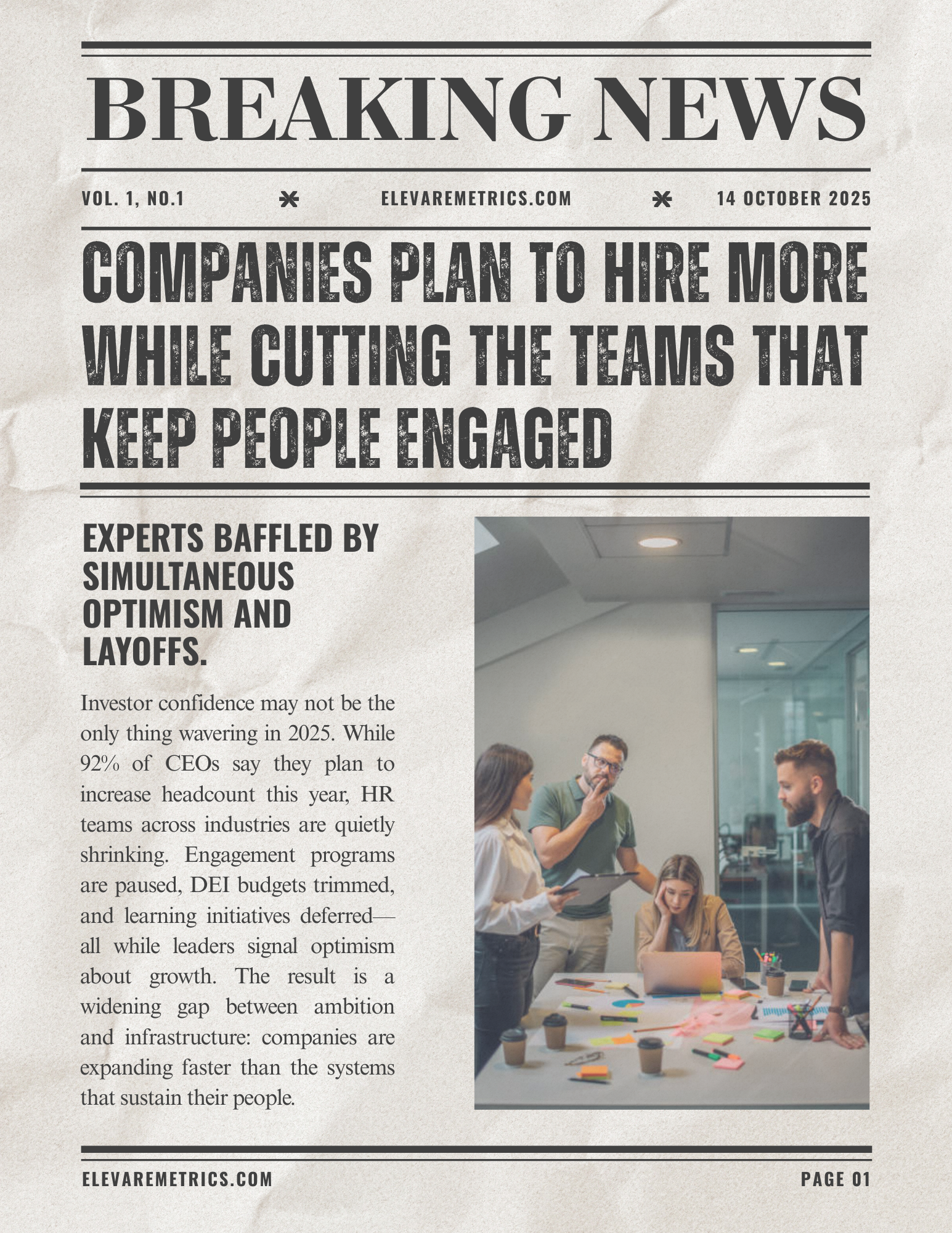
Investor confidence may not be the only thing wavering in 2025. While 92% of CEOs say they plan to increase headcount this year (KPMG Global CEO Outlook 2025), HR teams across industries are quietly shrinking. Engagement programs are paused, DEI budgets trimmed, and learning initiatives deferred, all while leaders signal optimism about growth.
It’s a paradox playing out across boardrooms and breakrooms alike: companies are doubling down on expansion, yet pulling back investment in the very people systems that make that expansion possible. The result isn’t just an HR issue, it’s a strategic blind spot that threatens culture, retention, and long-term performance.
At Elevare Metrics, we’ve seen this same tension play out across dozens of organizations, leaders are eager to grow but hesitant to invest in the systems that help people thrive. It’s a familiar pattern: expansion goals rise faster than engagement budgets.
1. The Disconnect Between Ambition and Infrastructure
According to HR Dive’s 2025 Midyear HR Checkup, many organizations are seeing “a large-scale divestment from people initiatives.” Budgets for engagement, learning, and DEI are being reallocated to technology or efficiency measures, while HR leaders report being overextended and understaffed.
At the same time, economic optimism remains high at the top. KPMG’s survey found that nearly all CEOs expect business expansion in the coming 12 months, and 92% intend to grow their workforce. In other words, strategy says “grow,” but budgets say “cut.”
That contradiction might look harmless on paper, but inside organizations, it’s eroding the infrastructure of trust and communication that growth depends on.
2. Cutting Engagement Costs More Than It Saves
The data suggests that scaling without engagement isn’t just risky, it’s expensive. Businessolver’s 2025 State of Workplace Empathy Report found that companies that cut DEI and engagement programs faced 32% higher attrition within a year.
Turnover is already one of the biggest hidden costs in business. Replacing a mid-level employee can cost 1.5 – 2× their annual salary (Gallup, 2024). When leaders cut people programs under the banner of “efficiency,” they often trade short-term savings for long-term instability.
If disengagement takes hold, hiring more people won’t fix the problem, it only scales the dysfunction.
3. Technology Isn’t a Substitute for Culture
Another reason for this paradox lies in where growth dollars are going. The KPMG report noted that CEOs are prioritizing AI and digital transformation investments, sometimes at the expense of human capital.
This isn’t inherently wrong, AI and automation can create real efficiencies, but as HR Dive and Forbes have both reported, many early AI implementations have resulted in layoffs and restructured departments. The intent is often “redeployment,” but the perception among employees is uncertainty and loss of trust.
When organizations automate without clear communication or reskill paths, they don’t just change processes, they change culture. And culture, unlike code, doesn’t rebuild overnight.
4. A Smarter Way Forward
If The organizations that navigate this paradox successfully will do two things at once:
- Pursue innovation and efficiency through technology and transformation.
- Reinforce the human foundation, listening, development, recognition, and belonging, that allows growth to stick.
This isn’t sentimental; it’s strategic. As Gartner’s 2025 HR Trends report noted, companies that maintain strong engagement during transformation are 2.6× more likely to hit growth targets.
Growth without support is expansion without stability.